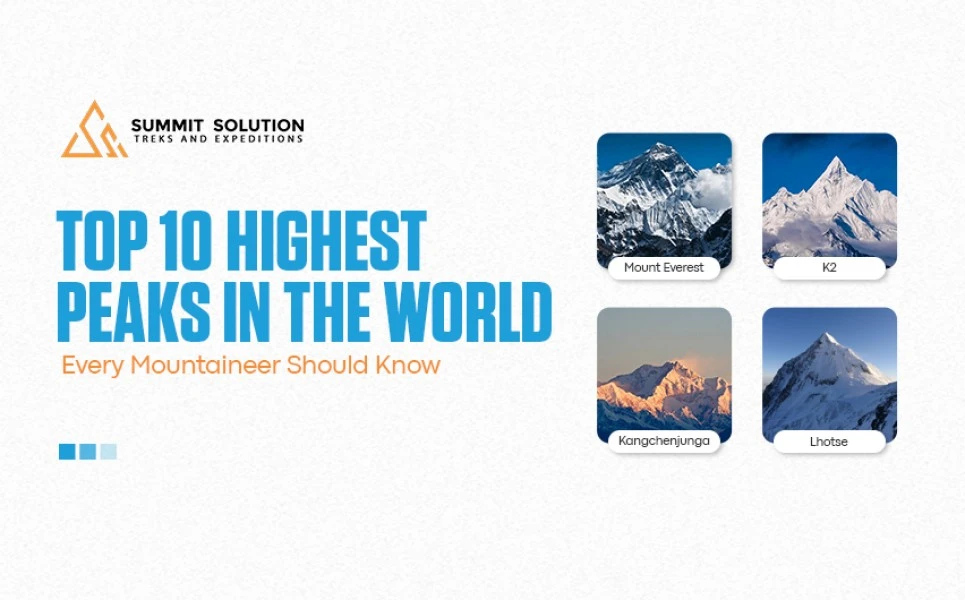
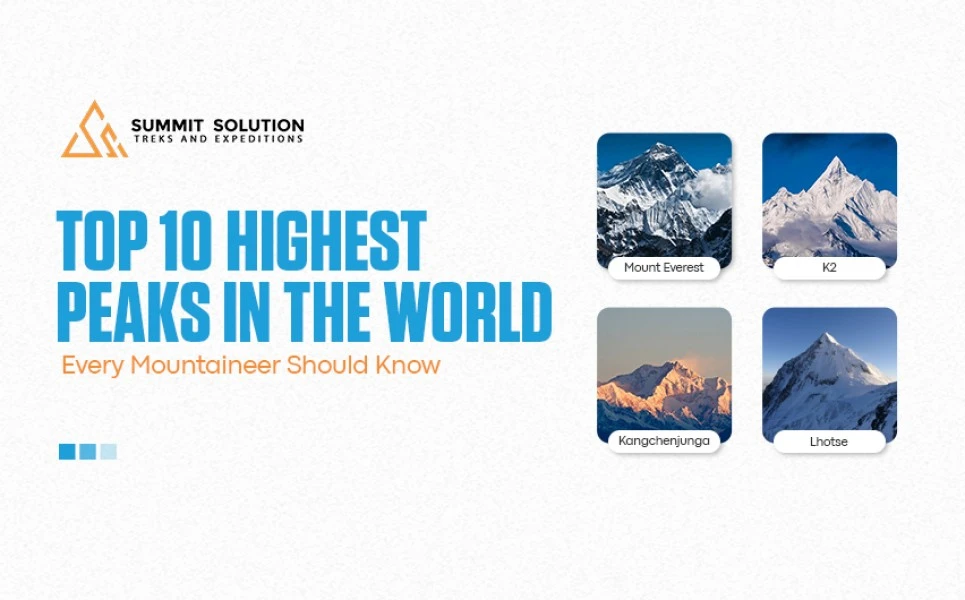
There are 14 peaks above 8,000 meters on Earth. Every single one sits in Asia and spreads across the Nepal Himalayas and the Karakoram range of Pakistan. These are the top 10 highest peaks in the world, and for any serious mountaineer, they represent the ultimate challenge.
Whether you're planning your first high altitude expedition or ticking off the eight thousanders one by one, knowing these peaks, their height, history, and character is where every mountaineering journey starts.
The world’s top ten highest mountains are all located in the continent of Asia in the Himalayas or Karakoram Mountain ranges. Each of these peaks has its own past, challenge, and history of mountaineering. This section gives a brief overview of these legendary peaks.
|
# |
Name of Mountain |
Height of Mountain |
Place of Location |
|
1 |
Mount Everest |
8,848 m |
Nepal/ China |
|
2 |
K2 |
8,611 m |
Pakistan / China |
|
3 |
Kangchenjunga |
8,586 m |
Nepal / India |
|
4 |
Lhotse |
8,516 m |
Nepal / China |
|
5 |
Makalu |
8,485 m |
Nepal / China |
|
6 |
Cho Oyu |
8,188 m |
Nepal / China |
|
7 |
Dhaulagiri I |
8,167 m |
Nepal |
|
8 |
Manaslu |
8,163 m |
Nepal |
|
9 |
Nanga Parbat |
8,126 m |
Pakistan |
|
10 |
Annapurna I |
8,091 m |
Nepal |
Not all eight thousanders are equal. Here is how the top 10 rank by fatality rate and technical difficulty which is essential reading before any summit attempt.
|
Peak |
Fatality Rate |
Technical Grade |
Best Suited For |
|
Cho Oyu |
~1% |
PD (moderate) |
First 8000m attempt |
|
Mount Everest |
~1.2% |
AD (technical) |
Guided & experienced climbers |
|
Manaslu |
~3% |
AD+ |
Well-prepared climbers |
|
Lhotse |
~3.5% |
AD-D |
Experienced alpinists |
|
Kangchenjunga |
~8% |
D (difficult) |
Expert mountaineers |
|
Dhaulagiri I |
~9% |
D-ED |
Expert mountaineers |
|
Makalu |
~9.5% |
ED (extreme) |
Elite alpinists |
|
Nanga Parbat |
~20% |
ED |
Elite alpinists only |
|
K2 |
~25% |
ED+ |
World-class alpinists |
|
Annapurna I |
~32% |
ED+ |
Expert only - extreme risk |
|
Height |
8,848 m (29,032 ft) |
|
Location |
Mahalangur Himal, Nepal / China |
|
First Ascent |
29 May 1953 - Sir Edmund Hillary & Tenzing Norgay Sherpa |
|
Difficulty |
Moderate-technical | Commercially guided | Very high traffic |
The tallest mountain in the world is Mount Everest, which rises to an elevation of 8,848 meters in height. Its name in Nepali is Sagarmatha while its name in Tibetan is Chomolungma. It stands on the border between Nepal and China within the Mahalangur Himal range.
The two most common approaches for climbing Mount Everest include the Southeast Ridge approach from Nepal and the North Ridge approach from Tibet. Even with the modern equipment and professional guides used today, climbing it is still very risky.
Summit Solution Expeds runs fully supported including Everest programs for both guided and independent climbers.
|
Height |
8,611 m (28,251 ft) |
|
Location |
Karakoram range, Pakistan / China |
|
First Ascent |
31 July 1954 - Achille Compagnoni & Lino Lacedelli (Italian) |
|
Difficulty |
Highly technical | Extreme risk | Lowest summit-to-attempt ratio |
Standing at 8,611 meters (28,251 feet) high, K2 is the world's second-highest mountain and is famously difficult to climb. Situated in the Karakoram range in Pakistan, K2's challenging rock faces, harsh weather conditions, and frequent avalanches have given it the title of 'Savage Mountain.'
It is estimated that approximately one in every four climbers who have reached the top of K2 has perished. Recently, in January 2021, an unprecedented winter ascent of K2 by a 10-person Nepalese expedition team marked a significant milestone for mountaineering.
|
Height |
8,586 m (28,169 ft) |
|
Location |
Himalayas, Nepal / India (Sikkim) |
|
First Ascent |
25 May 1955 - George Band & Joe Brown (British) |
|
Difficulty |
Very technical | Remote | Spiritually significant |
Kangchenjunga is the third tallest peak in the world. It is located on the boundary between Nepal and Sikkim state of India. The name of this peak signifies "Five Treasures of Snow" due to the presence of five summits in the peak, which have religious significance for the local tribes.
In accordance with the local traditions, mountaineers do not climb up to the top point.
|
Height |
8,516 m (27,940 ft) |
|
Location |
Mahalangur Himal, Nepal / China |
|
First Ascent |
18 May 1956 - Ernst Reiss & Fritz Luchsinger (Swiss) |
|
Difficulty |
Technical | South Face is one of climbing's hardest routes |
The Lhotse mountain stands fourth tallest in the world but shares its base camp with the Mount Everest through the Western Cwm route. The vertical south face of the mountain, measuring about 3,200 meters, presents a daunting climbing challenge.
Despite the prominence of its neighboring mount, Lhotse presents a challenging climb that does not attract hordes of people. For the climber who is tired of climbing Everest, Lhotse provides the natural progression point for further adventure.
|
Height |
8,485 m (27,838 ft) |
|
Location |
Mahalangur Himal, Nepal / China |
|
First Ascent |
15 May 1955 - Jean Couzy & Lionel Terray (French) |
|
Difficulty |
Highly technical | Isolated | Pyramid-shaped |
The fifth-highest peak in the world, the Makalu is among the hardest peaks to climb because of its perfectly shaped four-sided pyramid formation, which ensures that all approaches to the summit will be extremely strenuous.
Situated 19 km southeast of Everest, in the Makalu-Barun National Park, there are very few attempts made by climbers compared to neighboring peaks, thus providing perfect opportunities for mountaineering expeditions at altitude.
|
Height |
8,188 m (26,864 ft) |
|
Location |
Mahalangur Himal, Nepal / China |
|
First Ascent |
19 Oct 1954 - Herbert Tichy, Sepp Jöchler, Pasang Dawa Lama |
|
Difficulty |
Most accessible 8000m peak | Good first eight thousander |
Cho Oyu stands sixth in height among all peaks around the world and is the most climbed mountain that crosses 8,000 meters high mark. In Tibetan language, its name means "Turquoise Goddess". The easy northwest ridge route is what makes it the best choice for the first ascent of an 8,000 meter high peak.
It lies on the border between Nepal and Tibet to the west of Mount Everest.
|
Height |
8,167 m (26,795 ft) |
|
Location |
Dhaulagiri Himal, Nepal |
|
First Ascent |
13 May 1960 - Austrian-Swiss-Nepali expedition |
|
Difficulty |
Technical | Remote | Notorious for storms |
The Dhaulagiri I is the world’s seventh highest mountain. It is the highest mountain wholly in Nepal. The name Dhaulagiri I, derived from Sanskrit language, means “the white mountain.” Before the 19th century, Dhaulagiri was thought to be the highest mountain in the entire world.
The mountain is extremely remote and stormy, thus rarely visited by mountaineering groups. A wrecked plane belonging to an expedition to the Dhaulagiri I back in 1960 is located in Dhaulagiri Icefall area.
|
Height |
8,163 m (26,781 ft) |
|
Location |
Mansiri Himal, Nepal |
|
First Ascent |
9 May 1956 - Toshio Imanishi & Gyalzen Norbu (Japanese) |
|
Difficulty |
Technical | Increasingly popular | Permit required |
Standing at the height of eight thousand meters and making up one of the eight highest peaks of the world, Manaslu is the tallest mountain in the Gorkha district of Nepal. In Sanskrit, Manaslu literally means 'Mountain of the Spirit.' This peak has been associated with Japanese climbers as it was first climbed by a Japanese expedition team.
Climbing Manaslu is a challenge that you can take if you are prepared well enough, as this peak is a good step towards climbing other mountains.
|
Height |
8,126 m (26,660 ft) |
|
Location |
Himalayas, Pakistan |
|
First Ascent |
3 July 1953 - Hermann Buhl (solo, Austrian) |
|
Difficulty |
Extreme | High fatality rate | Three massive faces |
Nanga Parbat ranks as the ninth tallest mountain in the world. Nanga Parbat is also considered to be among the most dangerous mountains of all time due to the many deaths associated with it in the early stages of its exploration. The first ascent of Nanga Parbat was made by Hermann Buhl in 1953 in a completely solo climb that did not use supplemental oxygen.
Nanga Parbat has three enormous faces namely; Rupal, Diamir, and Rakhiot. The Rupal Face stands out as the tallest mountain face in the world rising at a height of 4,600 meters.
|
Height |
8,091 m (26,545 ft) |
|
Location |
Annapurna Himal, Nepal |
|
First Ascent |
3 June 1950 - Maurice Herzog & Louis Lachenal (French) |
|
Difficulty |
Extreme | Highest fatality rate of all eight thousanders |
Standing at a height of tenth in the list of highest mountains of the world, Annapurna is the deadliest peak, which boasts an alarming death rate for climbers as high as 32 percent. Interestingly, it is also the first eight thousand feet mountain to be conquered successfully by French mountaineers in the year 1950.
The name "Annapurna" was chosen in honor of the Hindu goddess who is believed to provide food to all living beings. Annapurna is located in central Nepal and is one of the favorite destinations for mountaineers as far as trekking in Nepal is concerned.
Not only are the ten tallest mountains in the world the tallest on Earth, but they also stand as the ultimate challenge to endurance, technical ability, and high-altitude survival.
Each of them lies in the death zone: All ten peaks rise above 8,000 meters , the level at which it is impossible to survive without supplementary oxygen. Each ascent is a race against time before the deteriorating effects set in.
All fourteen of the 8,000-meter summits lie in Asia: Eight of the ten tallest peaks are located in the Nepal Himalayas, while the other two, K2 and Nanga Parbat, form part of the Karakoram of Pakistan. There are none like them anywhere else in the world.
One range, two unique tests: While Himalayan climbs are better prepared with permit systems in place, the Karakoram requires superior mountaineering skills and greater self-sufficiency. The choice of one tells us what kind of mountaineer you are.
Summits which shaped the modern age: From the ascent of Annapurna I, the first 8,000-meter summit reached in 1950, to the winter ascent of K2 in 2021, each climb tells a story of the greatest adventures in man's history.
Many are laden with profound spiritual importance: The peak of Kangchenjunga remains unclimbed according to custom. Cho Oyu is worshipped as the Blue Goddess. The name Annapurna derives from the Hindu deity of food and sustenance. These are not simply geographic entities. They are also holy sites.
A mere fifty individuals have climbed all 14 eight thousanders so far: Climbing the ten tallest mountains on earth is practically an entire lifetime's goal for most climbers. These mountains are not goals to conquer. They are lifelong endeavors.
The eight thousanders aren’t just peaks; they’re life-changing achievements. No matter if you’re tackling your very first 6000 meters peak or planning a complete eight thousander expedition, proper preparation makes all the difference.
Summit Solution Expeds is dedicated to providing expert high-altitude expeditions in both Nepal and Pakistan. Experience the entire range of our expeditions, from Everest to the Karakoram.
The highest peak of the world is Mount Everest, which stands at an elevation of 8,848 meters above sea level. The height of this mountain was found out after the joint measurement survey performed by Nepal and China in 2020.
The second highest peak of the world is the K2 mountain, with an elevation of 8,611 meters above sea level. It is located in the Karakoram mountain range situated on the borders of China and Pakistan and is harder to climb than Mount Everest.
An eight-thoussander peak means a mountain with an elevation of 8000 meters above sea level. Currently, there are precisely 14 eight-thousanders in the world that fall into the Himalayas and Karakoram ranges in Asia.
Mount Everest is the highest peak in Nepal, which borders China. Inside Nepal's territory, Kangchenjunga and Lhotse are the two other tall mountains, respectively.
The death zone is an altitude of over 8,000 meters where the level of oxygen present cannot support human life for a significant period of time. At this height, climbers will rapidly deteriorate physically and will need to make a quick summit.
Cho Oyu, with an elevation of 8,188 meters, is known to be the easiest of all eight thousands due to its less complicated northwest ridge route and shorter trekking route. This mountain is also suggested as the best option for the first summit for climbers aiming for peaks beyond 8,000 meters.
Annapurna I is known to have the highest death toll out of all eight thousands, having one in three climbs result in fatalities. K2 and Nanga Parbat also present extremely dangerous climbing opportunities.
The ten highest mountains in the world represent the ten tallest mountains on earth and are all above 8,000 meters in height.
Share with Friends: