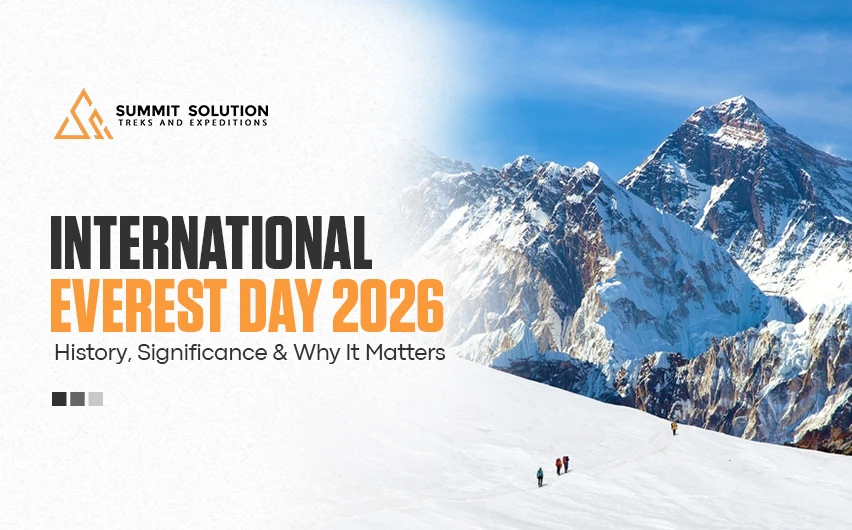
Mount Everest Day is celebrated on May 29 around the world to mark one of the greatest feats in human history. It is the day to celebrate the first successful ascent of Mount Everest , which is the tallest mountain on planet earth .
But Everest is not famous solely for its height. It is famous too for its beauty, danger and the fortitude it takes to climb it. For many, Everest represents dreams, determination and adventure.
It is observed on 29th May annually as Everest Day. The day is the great accomplishment of the first time climbers to reach the peak of Mt. Everest.
Edmund Hillary and Tenzing Norgay reached the peak of Mt. Everest on 29th May 1953.
Their historic achievement inspired countless adventurers around the world. Every year, Nepal celebrates International Everest Day to honor the mountaineers, Sherpa community, and the greatness of Mount Everest itself.
The occasion commemorates tourism and environmental conservation as well today.
It is situated in the Himalayan mountain range that lies between Nepal and
China’s Tibet. Its southern slope falls within Nepal’s Sagarmatha National Park, while its northern slope belongs to China’s Tibet. Nepal refers to the peak as Sagarmatha, which means "forehead of the sky"; local Tibetan communities call it Qomolangma, which translates to "Mother of the Earth".
This entire region is dotted with glaciers and snow-capped mountains, boasting extremely magnificent mountain landscapes.
Type of measurement
Height Meters 8,848.86 m
Feet 29,031.7 ft
Mount Everest is the highest mountain in the world. It is for its remarkable height that people come from across the globe to climb Everest.
Everest is still being studied by numerous experts even today since the mountain is changing somewhat owing to tectonic action.
The history of Mount Everest is that of adventure, courage, and discovery.
A number of individuals had believed that the climbing of the mountain was beyond any individual’s capabilities before they actually did it. Numerous climbers from various countries tried, but were pushed back due to bad weather and rough terrain.
In 1953, Sir Edmund Hillary and Tensing Norgay became the first climbers to summit Everest.
They changed the history of mountaineering forever.
Everest then became one of the world’s most famous adventure locations.
Today, climbers from many countries dream of climbing Everest at least once in their life span.
Mount Everest Day is not merely a festival for mountain climbers. It has profound significance for Nepal and the world over.
This day is observed in recognition of the bravery and efforts made by mountaineers for scaling the dangerous mountains.
One requires energy, patience, and determination to scale Mount Everest. The day thus pays respect to all who scale such high mountains.
Sherpas play a very essential part in ascending Mount Everest.
They provide assistance with gear and route-setting.
It would not be possible for the climbers to scale Mount Everest without their help.
The day is also dedicated to the services provided by the Sherpa community to mountaineering.
Tourism is one of the prominent industries of Nepal.
Each year thousands of tourists come to Nepal to trek and climb in the Everest Base Camp area.
Therefore, this day of Mount Everest would be helpful in attracting more people in the country and would benefit in the business of hotels, trekking agencies, tea houses, mountain guides etc.
Mount Everest is facing an alarming problem regarding pollution.
Alas, the mountain is getting littered with trash and plastic objects and with thrown away climbing gear.
This is the reason why “Mount Everest Day” is useful to sensitize people on the significance of conserving nature and wildlife.
The normal period of time required for climbing Mount Everest is 6-10 weeks. This involves trekking, acclimatisation, preparation to summit and back trekking. It's a very important thing to plan and be patient on a successful climb.
Here is the estimated time for climbing mount everest :
|
Activity |
Estimated Time |
|
8–12 days |
|
|
Acclimatization |
2–3 weeks |
|
Summit Preparation |
1 week |
|
Summit Ascent |
5–10 days |
|
Return Journey |
4–7 days |
Mount Everest has very low temperatures all year round. In winter temperatures can drop below -40°C around the peak. Heavy snowfall, avalanches, frozen terrain, lack of oxygen and strong winds are also a natural part of the experience at Mount Everest.
|
Weather Conditions |
|
|
|
|
|
This table shows the temperatures of different seasons :
|
Season |
Average Temperature |
|
Winter |
-40°C to -60°C |
|
Spring |
-20°C to -30°C |
|
Summer |
-10°C to -20°C |
But, the weather conditions make the majority of Everest climbers make a choice of spring for climbing the highest peak in the world.
Ideal times for mountaineering at Everest:
Spring season (March-May):
It's an ideal time for mountaineering in terms of weather.
Autumn season (September-November):
The best season for climbing Everest due to beautiful skies and magnificent views of mountains.
In the winter season, it is very hazardous, because of cold weather and stormy climate.
One of the most difficult activities is mountaineering up to Everest.
Not even the most practiced climbers will find it easy to navigate the challenges that the adventure will throw them.
1. Low O2: Oxygen levels are quite bad at high altitude. So, it gets tough to breathe.
2. Deep Freeze : Cold temperatures can lead to frostbite and other major health problems.
3. Avalanches : One of the major threats on Everest are avalanches.
4. Sickness at altitude : Headaches, dizziness and weakness are common problems for many climbers at high altitude.
5. Physical Tiredness : Physically healthy and mentally tough are needed to scale Everest.
Here are some amazing facts about Mount Everest that many people don’t know.
Everest is still growing : Tectonic plates are on the move, adding a few millimeters to Mount Everest each year.
Over 6,000 People Have Summited Everest : Many climbers from all across the world have reached the summit of Everest.
Air is Thin : At the summit oxygen is just approximately one-third of what it is at sea level.
Everest has many routes : There are two main routes of ascent, from Nepal and Tibet.
Sherpas Understand Everest : Sherpas are noted for their talent and experience in mountain climbing around the world.
Not everyone reaches the top of Everest.
Many like to do the legendary trek to Everest Base Camp.
It is one of the most popular trekking trips in Nepal.
Trekkers can enjoy:
Mountain vistas in the snow
Sherpa culture
Pretty villages
rivers and glaciers
Himalayan landscape
And the trip is far safer than the peak climb.
Mount Everest is a huge part of the economy of Nepal.
Tourism Support:
Hotels
Trekking agencies
Local Guide
Airport porters
Dining
Tea Rooms
Everest tourism brings revenue and a better living standards for many local residents.
Everest is magnificent, but it also has environmental problems.
Major Environmental Issues:
Trash Pollution : Some climbers leave oxygen bottles, plastic debris and climbing equipment behind them.
Glaciers melting : Glaciers around Everest are melting quicker due to climate change.
Human Excrements : The problem of garbage on Everest is becoming grave.
Clean Up Campaigns : Fortunately, Nepal and other organizations are trying to clean up Everest.Each year clean-up teams take down tons of garbage from the mountain.
Typical activities include:
Events for adventure tourism
Mountain clean-up projects
Awards ceremonies
Culture performances .
Educational, training, and extension programs
Some schools and tourism companies also conduct awareness campaigns on mountain safety and environmental protection.
Mount Everest has made many climbers famous around the world. Their achievements continue to inspire millions of people.
|
Mountaineer |
Country |
|
Sir Edmund Hillary |
New Zealand |
|
Tenzing Norgay |
Nepal |
|
Reinhold Messner |
Italy |
|
Apa Sherpa |
Nepal |
|
Pasang Lhamu Sherpa |
Nepal |
Climbing Mount Everest is more than just an adventure - it teaches powerful life lessons that can inspire us in everyday life.
Never Give Up : The journey to Everest is full of challenges. Climbers learn to stay patient, strong, and determined even when things become difficult.
Success Takes Preparation : Reaching the summit requires proper planning, training, and discipline. Everest teaches us that preparation is the foundation of success.
Teamwork Is Essential : No one climbs Everest alone. Trust, teamwork, and supporting each other are important for reaching the goal safely.
Respect Nature and Limits : Everest shows how powerful nature can be. Climbers learn to respect the mountains, weather, and their own physical limits.
Small Steps Lead to Big Goals : The summit is reached one step at a time. Everest reminds us that consistent effort eventually leads to great achievements.
Courage Creates History : The achievement of Sir Edmund Hillary and Tenzing Norgay proved that courage and determination can inspire the entire world.
Failure Is Part of Growth : Many climbers turn back before reaching the summit, but they return stronger and wiser. Everest teaches us that setbacks are part of the journey to success..
Everest is Nepal’s pride.
The mountain is a symbol of:
Natural beauty
Tourism Culture
Adventure
Economic development
Also, Everest allows Nepal to get international prominence all over the world.
International Everest Day celebrates the courage, determination, and historic achievement of Sir Edmund Hillary and Tenzing Norgay. The day also highlights the beauty and importance of Mount Everest while promoting adventure tourism and environmental awareness in Nepal.
For many travelers, visiting the Everest region is a once-in-a-lifetime experience filled with breathtaking mountain views and rich Sherpa culture. Those planning a safe and memorable trekking journey in Nepal can choose Summit Solution Treks & Expeditions for an unforgettable Himalayan adventure.
Mount Everest Day commemorates the successful ascent of Mount Everest by Sir Edmund Hillary and Tenzing Norgay in 1953, and is observed each year on May 29.
International Everest Day was officially started by the Government of Nepal in 2008 after the death of Sir Edmund Hillary i.e May 29, 1953.
The height of Mount Everest is 8,848.86 meters.
Yes, Everest Day is celebrated globally with climbing events, exhibitions, and tributes to Sir Edmund Hillary and Tenzing Norgay.
Mount Everest is famous for being the tallest mountain in the world.
Share with Friends: